The equipment
Wing
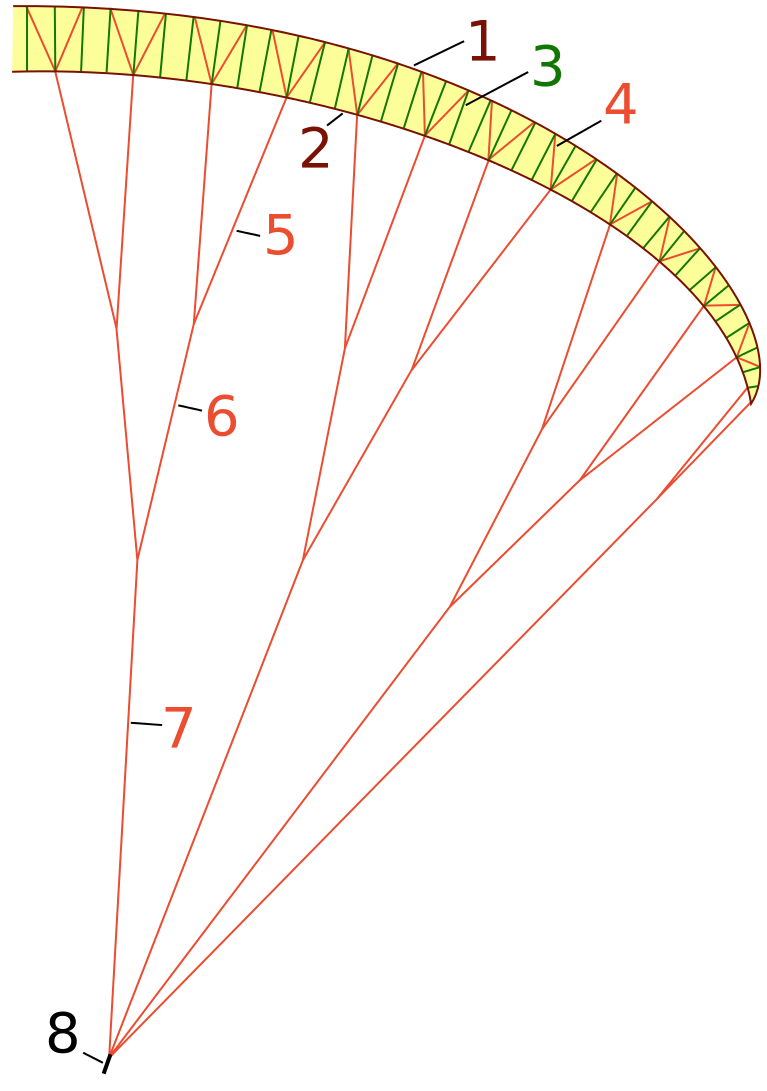 Transverse cross section showing parts of a paraglider:
- upper surface
- lower surface
- rib
- diagonal rib
- upper line cascade
- middle line cascade
- lower line cascade
- risers
The paraglider wing or canopy is usually what is known in engineering as a "ram-air airfoil". Such wings comprise two layers of fabric that are connected to internal supporting material in such a way as to form a row of cells. By leaving most of the cells open only at the leading edge, incoming air keeps the wing inflated, thus maintaining its shape. When inflated, the wing's cross-section has the typical teardrop aerofoil shape. Modern paraglider wings are made of high-performance non-porous materials such as ripstop polyester or nylon fabric.
In some modern paragliders (from the 1990s onwards), especially higher-performance wings, some of the cells of the leading edge are closed to form a cleaner aerodynamic profile. Holes in the internal ribs allow a free flow of air from the open cells to these closed cells to inflate them, and also to the wingtips, which are also closed.
The pilot is supported underneath the wing by a network of suspension lines. These start with two sets of risers made of short (40 cm) lengths of strong webbing. Each set is attached to the harness by a carabiner, one on each side of the pilot, and each riser of a set is generally attached to lines from only one row of its side of wing. At the end of each riser of the set, there is a small delta maillon with a number (2-5) of lines attached, forming a fan. These are typically 4–5 metres long, with the end attached to 2−4 further lines of around 2 m, which are again joined to a group of smaller, thinner lines. In some cases this is repeated for a fourth cascade.
The top of each line is attached to small fabric loops sewn into the structure of the wing, which are generally arranged in rows running span-wise (i.e., side to side). The row of lines nearest the front are known as the A lines, the next row back the B lines, and so on.[14] A typical wing will have A, B, C and D lines, but recently, there has been a tendency to reduce the rows of lines to three, or even two (and experimentally to one), to reduce drag.
Paraglider lines are usually made from Dyneema or Kevlar. Although they look rather slender, these materials are immensely strong. For example, a single 0.66 mm-diameter line (about the thinnest used) can have a breaking strength of 56 kg.
The glide ratio of paragliders ranges from 9.3 for recreational wings to about 11.3 for modern competition models, reaching in some cases up to 13. For comparison, a typical skydiving parachute will achieve about 3:1 glide. A hang glider ranges from 9.5 for recreational wings to about 16.5 for modern competition models. An idling (gliding) Cessna 152 light aircraft will achieve 9:1. Some sailplanes can achieve a glide ratio of up to 72:1.
The speed range of paragliders is typically 20–75 kilometres per hour (12–47 mph), from stall speed to maximum speed. Beginner wings will be in the lower part of this range, high-performance wings in the upper part of the range.
For storage and carrying, the wing is usually folded into a stuffsack (bag), which can then be stowed in a large backpack along with the harness. For pilots who may not want the added weight or fuss of a backpack, some modern harnesses include the ability to turn the harness inside out such that it becomes a backpack.
Paragliders are unique among human-carrying aircraft in being easily portable. The complete equipment packs into a rucksack and can be carried easily on the pilot's back, in a car, or on public transport. In comparison with other air sports, this substantially simplifies travel to a suitable takeoff spot, the selection of a landing place and return travel.
Tandem paragliders, designed to carry the pilot and one passenger, are larger but otherwise similar. They usually fly faster with higher trim speeds, are more resistant to collapse, and have a slightly higher sink rate compared to solo paragliders.
Harness
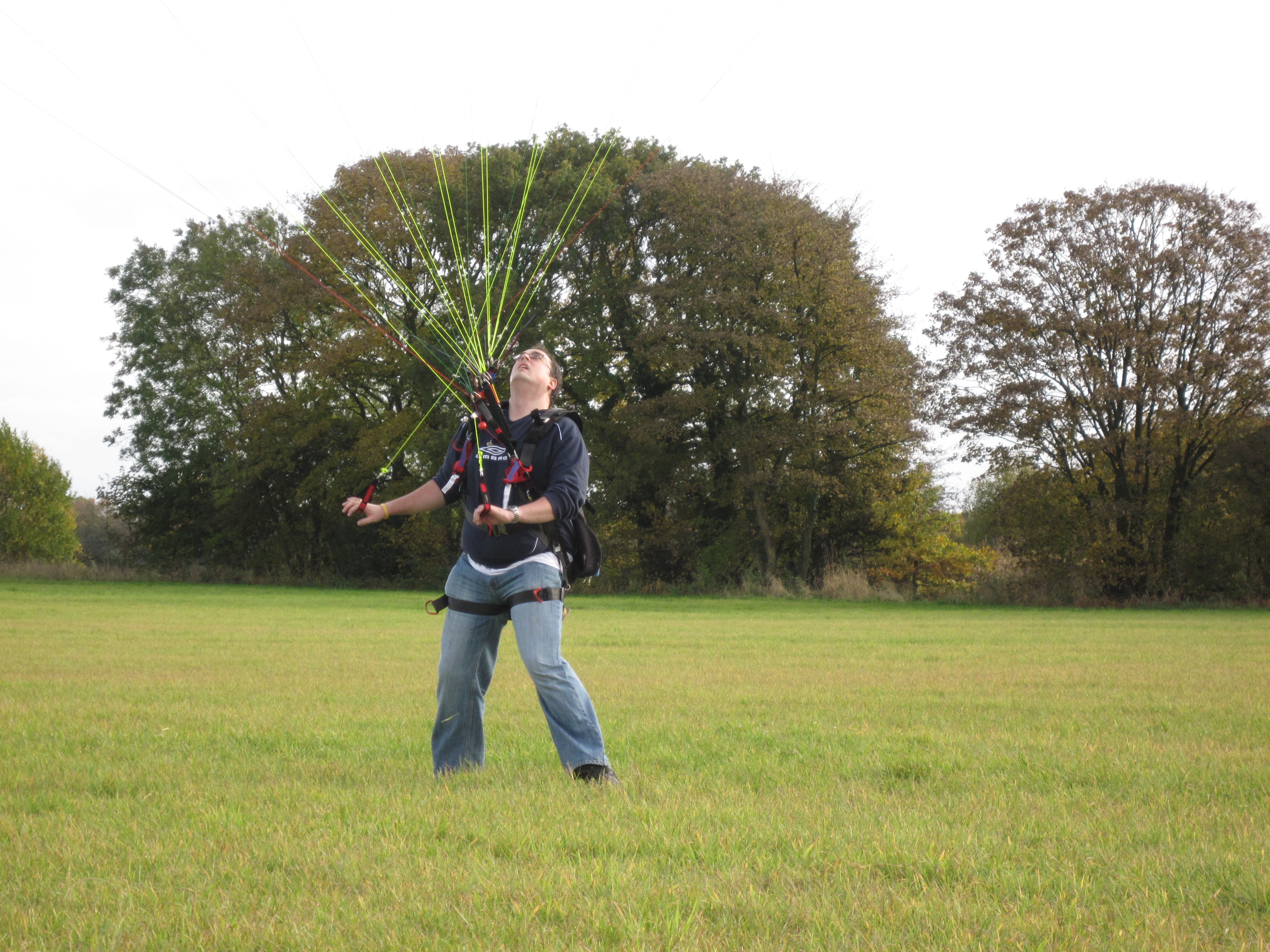 A pilot performing wing control for a reverse launch.
The pilot is loosely and comfortably buckled into a harness, which offers support in both the standing and sitting positions. Most harnesses have foam or airbag protectors underneath the seat and behind the back to reduce the impact on failed launches or landings. Modern harnesses are designed to be as comfortable as a lounge chair in the sitting or reclining position. Many harnesses even have an adjustable "lumbar support". A reserve parachute is also typically connected to a paragliding harness.
Harnesses also vary according to the need of the pilot, and thereby come in a range of designs, mostly: Training harness for beginners, Pax harness for tandem passengers that often also doubles as a training harness, XC Harness for long distance cross country flights, All round harness for basic to intermediate pilots, Pod harness, which is for intermediate to pro pilots that focus on XC. Acro harnesses are special designs for acrobatic pilots, Kids tandem harnesses are also now available with special child-proof locks.
Instruments
Most pilots use variometers, radios, and, increasingly, GPS units when flying.
Variometer
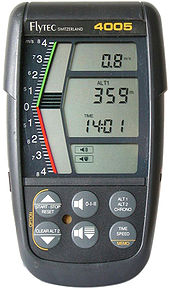
Variometer
The main purpose of a variometer is in helping a pilot find and stay in the "core" of a thermal to maximise height gain and, conversely, to indicate when a pilot is in sinking air and needs to find rising air. Humans can sense the acceleration when they first hit a thermal, but cannot detect the difference between constant rising air and constant sinking air. Modern variometers are capable of detecting rates of climb or sink of 1 cm per second. A variometer indicates climb rate (or sink-rate) with short audio signals (beeps, which increase in pitch and tempo during ascent, and a droning sound, which gets deeper as the rate of descent increases) and/or a visual display. It also shows altitude: either above takeoff, above sea level, or (at higher altitudes) flight level.
Radio
Radio communications are used in training, to communicate with other pilots, and to report where and when they intend to land. These radios normally operate on a range of frequencies in different countries—some authorised, some illegal but tolerated locally. Some local authorities (e.g., flight clubs) offer periodic automated weather updates on these frequencies. In rare cases, pilots use radios to talk to airport control towers or air traffic controllers. Many pilots carry a cell phone so they can call for pickup should they land away from their intended point of destination.
GPS
GPS (global positioning system) is a necessary accessory when flying competitions, where it has to be demonstrated that way-points have been correctly passed. The recorded GPS track of a flight can be used to analyze flying technique or can be shared with other pilots. GPS is also used to determine drift due to the prevailing wind when flying at altitude, providing position information to allow restricted airspace to be avoided and identifying one’s location for retrieval teams after landing out in unfamiliar territory. GPS is integrated with some models of variometer. This is not only more convenient, but also allows for a three-dimensional record of the flight. The flight track can be used as proof for record claims, replacing the "old" method of photo documentation.